Counselor Education & Research

Natalie M.
Ricciutti

Assistant Professor of Counseling · University of North Carolina Charlotte

Dedicated to advancing research for community readiness, substance use issues, and addiction counselors through a commitment to evidence-based and culturally responsive practices.

Natalie Ricciutti Natalie Ricciutti Natalie Ricciutti Natalie Ricciutti Natalie Ricciutti

Creating New Ways to Change Systemic Issues

Dr. Natalie M. Ricciutti is an Assistant Professor of Counseling at the University of North Carolina Charlotte. Her work sits at the intersection of changing community-wide problems, addiction treatment, and rigorous research methodology. She focuses on developing and testing novel tools to strengthen community awareness of systemic issues and addressing how future addiction counselors are prepared for practice.

With experiencing in addiction and mental health counseling, clinical supervision, instrument development, and community engagement, Dr. Ricciutti brings both scholarly rigor and a practitioner's perspective to her teaching and research. She is committed to fostering inclusive learning environments and mutually beneficial partnerships to support localized systemic change.

Addiction Counselor Training & Supervision

Research and teaching focused on preparing competent, ethically, and stigma-aware addiction and mental health counselors.

Instrument Development

Created and tested two original tools - the Community Readiness Instrument and the Behavioral Addiction Knowledge Survey.

Community Engaged Research

"Assessing community readiness is the first step toward creating systemic change. An easy way to do that is through the Community Readiness Instrument."

Academic Background

2022
Ph.D. in Counselor Education & Supervision
Kent State University
Dissertation: "Differences in Stigma Experienced by Licensed Counselors Toward Substance Use Disorders and Behavioral Addictions."
2018
M.S.Ed. in Clinical Mental Health Counseling
Youngstown State University
2016
B.S. in Psychology
The University of Mount Union

The Community Readiness Instrument

The CRI is an easy-to-use tool to measure a community's readiness to change a systemic problem. It is theoretically grounded in the Transtheoretical Model of Change and the longstanding Community Readiness Model. The CRI a psychometrically strong tool with promising reliability and validity evidence. Developed with clinicians and local advocates in mind, the CRI addresses a critical gap in community-engaged research.

Psychometrically Validated

Developed through rigorous methodology including exploratory factor analysis, second-order confirmatory factor analysis, and Rasch analysis.

Designed for Counselors and Community Advocates

The CRI is a practical tool for use in community-led and community-engaged research.

Published & Peer-Reviewed

Results and instrument details have been published in high-ranking journals.

At a Glance
47
Scale items
6
Subscales / Factors
Good - Excellent
McDonald's Omega for each factor
2025
First published

The Community Readiness Instrument

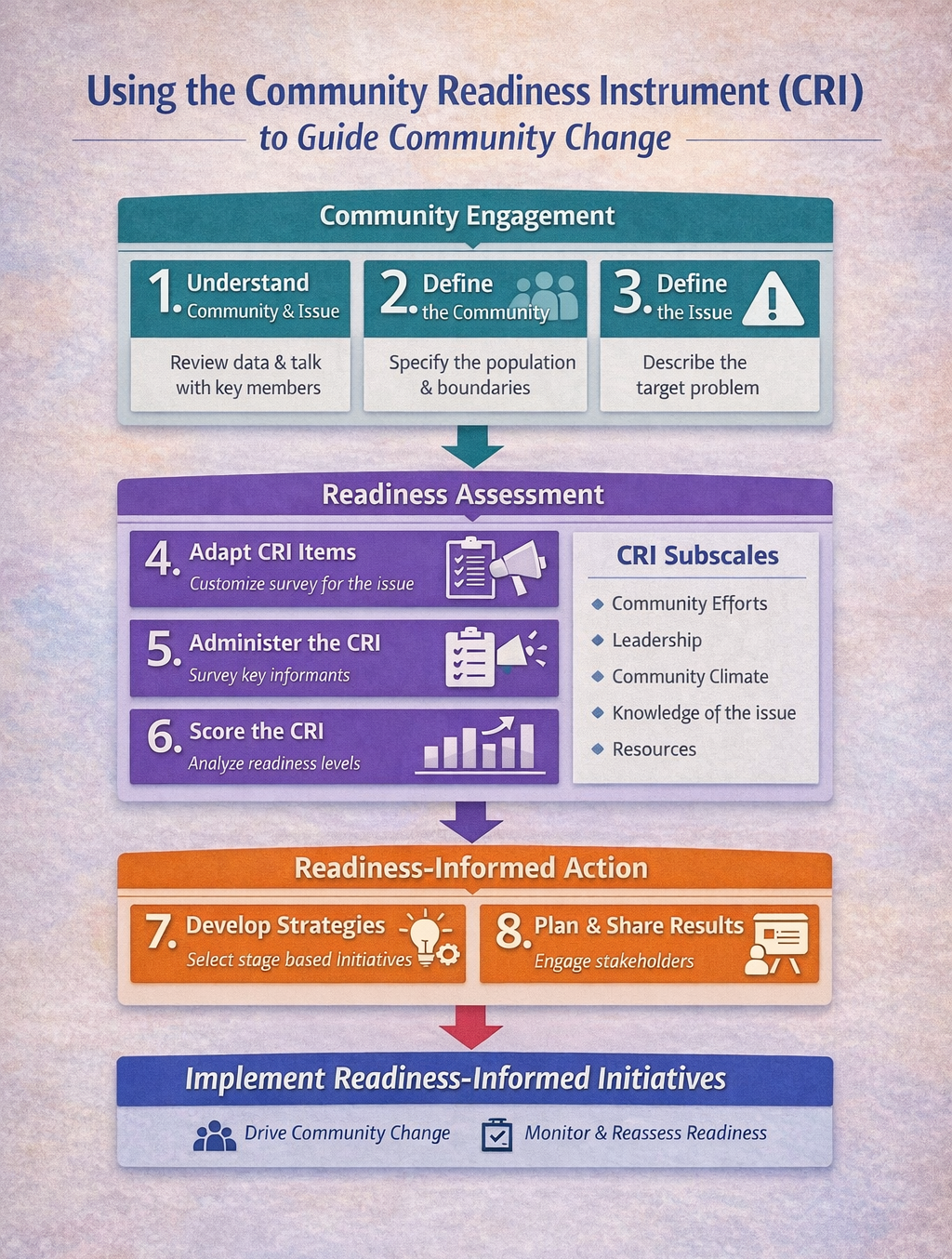
The CRI is an assessment of community readiness to change a specific issue. Issues can include any wide-spread issue a community is dealing with, such as substance use, homelessness, racism, and obesity. It was developed to provide clinicians and local advocates with a statistically and conceptually sound measure of community change readiness.

Based on the longstanding Community Readiness Model, the CRI includes 6 subscales which are each influential facets of community readiness. These are Efforts, Knowledge of Efforts, Leadership, Community Climate, Knowledge of Issue, and Resources. Each subscale includes 6-9 items, with the CRI including 47 total items.

Measuring community readiness is the first step in localized advocacy for change. Failing to assess community readiness before implementing new efforts can lead to failure or mixed success. The CRI is an easy-to-use way to ensure that the efforts created by local leaders and advocates will match the community's current readiness to change.

CRI Info
Presentations

Southern Association for Counselor Education and Supervision Conference

Louisville, KY

Ricciutti, N. M. (2026, November). Counselors and community advocacy: Teaching students to be community leaders and change agents. To be presented at the Southern Association for Counselor Education and Supervision Conference, Louisville, KY.

Association for Assessment and Research in Counseling Conference

Dallas, TX

Ricciutti, N. M. & Zhang, S. (2026, September). I made an instrument, now what? Testing four methods to determine scoring procedures and thresholds. To be presented at the Association for Assessment and Research in Counseling Conference, Dallas, TX.

Violence Prevention Research Conference

Portsmouth, NH

Ricciutti, N. M., Bright, M., & Kilka, B. (2026, July). Supporting the prevention of childhood sexual abuse and commercial sexual exploitation with rigorous research and evaluation: A showcase of CDC-funded projects. To be presented at the Violence Prevention Research Conference, Portsmouth, NH.

Dr. Jonnie H. McLeod Institute on Addiction

Charlotte, NC

Ricciutti, N. M. (2025, May). Community change readiness and substance use disorders: How counselors can initiate systemic change thorough their communities.

SACES 2024 Conference

Dallas, TX

Cureton, J. & Ricciutti, N. M. (2024, November). Comprehensive assessment to support change in every aspect of our work.

AARC 2024 Conference

Pittsburgh, PA

Ricciutti, N. M. (2024, September). The Community Readiness Instrument: Developing a rigorous quantitative measurement based on a qualitative model while maintaining the same theoretical frameworks.

Professional Training Webinar

Community readiness to change is the crucial first step toward creating community-wide prevention and intervention efforts. The Community Readiness Instrument (CRI) is a psychometrically strong, adaptable tool to measure how ready a community is to address a wide-spread problem. The concept of community readiness has been applied to systemic issues such as suicide, substance use, poverty, obesity, domestic violence, and violence toward diverse and minoritized groups. The CRI has been found to affectively and efficiently measure community readiness toward substance use. It is being adapted to the systemic issues of adverse childhood experiences, domestic violence, and substance use challenges after natural disasters. The goal of the CRI is to be an easy-to-use tool for helping professionals, local leaders, researchers, and change advocates to inform sustainable initiatives and support positive change in their communities.

Access Training

Preparing Future Substance Use and Addiction Counselors

Many helping professionals separate mental health and addiction issues, choosing to silo each one instead of addressing them both. This leads to clients being constantly referred to other professionals, sometimes having to work with one provider for mental health and the other for their substance use. This history of treatment has put considerable costs and burdens on clients and created a system where they need to see two counselors instead of one.

My research focuses on educational strategies to work with clients with co-occurring diagnoses. This includes teaching students to identify and decrease stigma toward addictions, holistic treatment practices, and Motivational Interviewing. As a licensed Addiction Counselor and Addiction Counselor Educator, I am well aware that mental health and substance use issues go hand-in-hand. I believe in the necessity of preparing future counselors to work with clients by addressing all issues they are seeking treatment for.

Publications

Journal of Substance Use and Addiction Treatment

Ricciutti, N. M., Siegel, J. A., Prowten, S. D., Alexander, A., Gondim, P., Peiper, L. J., & Cramer, R. J. (under review). Psychometric testing of the Harm Reduction Acceptability Scale-Revised among mental health providers. Journal of Substance Use and Addiction Treatment.

The Professional Counselor

Ricciutti, N. M. & Davis, W. (2025). Publication trends of addiction counseling: A content analysis of the frequency and content of addiction-focused articles in counseling journals. The Professional Counselor, 15(2), 115-130.

Journal of Addictions & Offender Counseling

Ricciutti, N. M. & Davis, W. (2024). Person-first language and addiction literature: The presence of labeling and emotional language in counseling articles. Journal of Addictions & Offender Counseling, 1-14.

Journal of Addictions & Offender Counseling

Ricciutti, N. M. & Zhang, S. (2024). A pilot study of the Behavioral Addictions Knowledge Survey: Ensuring students' knowledge about process/behavioral addictions. Journal of Addictions & Offender Counseling, 1-16.

Alcoholism Treatment Quarterly

Ricciutti, N. M. & Storlie, C. A. (2023). The experiences of clinical mental health counselors treating clients for process/behavioral addictions. Alcoholism Treatment Quarterly, 42(1), 27-44.

Journal of Counselor Preparation and Supervision

Ricciutti, N. M. (2023). Counselors' stigma toward substance use disorders and process/behavioral addictions: Increasing awareness and decreasing stigma in practice and educational settings. Journal of Counselor Preparation and Supervision, 17(3).

Alcoholism Treatment Quarterly

Ricciutti, N. M. (2023). Mental Health and Chemical Dependency Counselors' Stigma Toward Clients with Substance Use Disorders: Predictors of Stigma and Implications for Clinicians and Educators. Alcoholism Treatment Quarterly, 41(4), 394-407.

Presentations

Southern Association for Counselor Education and Supervision Conference

Louisville, KY

Reed, S., Littlebear, S., Ricciutti, N. M., & Butler, S. (2026, November). Minding the gap: Addiction counseling training, CACREP, and counselor education. To be presented at the Southern Association for Counselor Education and Supervision Conference, Louisville, KY.

Association for Counselor Education and Supervision Conference

Philadelphia, PA

Ricciutti, N. M. (2025). Strategies to decrease addiction stigma: Counselors' stigma toward individuals with addictions and how counselor educators can initiate change in their students.

Association for Counselor Education and Supervision Conference

Philadelphia, PA

DeDiego, A. & Ricciutti, N. M. (2025). Shifting counselor education to a harm reduction model.

North Carolina Counselors Association Annual Conference

Greensboro, NC

Ricciutti, N. M. (2024). Person-First Language and Addiction Treatment: Why the Language we use with Clients Matters and How it can Impact Institutionalized Stigma.

Association for Counselor Education and Supervision Conference

Denver, CO

Ricciutti, N. M. & Davis, W. (2023). Person-first language and addiction literature: The continued presence of pejorative, labeling, and disorder-first language in published counseling articles.

UNC Charlotte Cato College of Education's Multicultural Issues in Counseling Conference

Charlotte, NC

Ricciutti, N. M. & Davis, W. (2023). Person-first language and addictions literature: The continued presence of pejorative, labeling, and disorder-first language in published counseling articles and how counselors talk about addictions.

Curriculum Vitae

Download Dr. Ricciutti's full academic CV for a comprehensive overview of her publications, presentations, teaching experience, and service.

Download CV (PDF)